Type

Fundamental

17 courses
The Way of the BodhisattvaStructured Course

The Way of the Bodhisattva

The Way of the Bodhisattva is one of the most highly recommended texts of Khenpo Sodargye’s lifetime. He once said that among all the treatises he has translated and taught, this is the one that everyone should study thoroughly at least once. For those with faith, it guides the mind deeply into Buddhist principles and inspires a broad awakening of Bodhicitta. Even for those without faith, studying it can help reduce anger, stress, and suffering. If studied systematically from beginning to end, this text becomes a lifelong source of spiritual benefit. This course, taught by Khenpo Sodargye in 2006, consists of 201 lessons and carefully guides practitioners to cultivate Bodhicitta and enter the Bodhisattva path, using the clearest, most practical, and systematic approach to help students advance to higher dimensions of life and mind. "The Way of the Bodhisattva" is one of the most highly recommended texts of Khenpo Sodargye’s lifetime. He once said that among all the treatises he has translated and taught, this is the one that everyone should study thoroughly at least once. For those with faith, it guides the mind deeply into Buddhist principles and inspires a broad awakening of Bodhicitta. Even for those without faith, studying it can help reduce anger, stress, and suffering. If studied systematically from beginning to end, this text becomes a lifelong source of spiritual benefit. This course, taught by Khenpo Sodargye in 2006, consists of 201 lessons and carefully guides practitioners to cultivate Bodhicitta and enter the Bodhisattva path, using the clearest, most practical, and systematic approach to help students advance to higher dimensions of life and mind. 2006 201

The Words of My Perfect Teacher: A Complete Guide to the Preliminaries of the Great PerfectionStructured Course

The Words of My Perfect Teacher: A Complete Guide to the Preliminaries of the Great Perfection

Teachings by Khenpo Sodargye. "The Words of My Perfect Teacher: A Complete Guide to the Preliminaries of the Heart-Essence of the Vast Expanse from the Great Perfection" is a crucial practice text of the Nyingma School of Tibetan Buddhism. Authored by Patrul Rinpoche and expounded over four years by the contemporary master Khenpo Sodargye, this classic is revered as "the teacher without anger," serving as the foundation stone for countless practitioners entering the Dharma through its pure, undefiled teachings and accessible guidance. The entire work unfolds through two major frameworks: "the proper way to listen to spiritual teachings" and "the teachings themselves," systematically presenting the complete stages of Great Perfection preliminaries. "The proper way to listen" emphasizes approaching the Dharma with correct motivation and conduct, establishing the foundation of practice through bodhicitta and the pure perception of the Secret Mantrayana. "The teachings themselves" progress layer by layer, from the "common outer preliminaries" - the difficulty of finding the freedoms and advantages, impermanence of life, the defects of samsara, the infallibility of cause and effect, the benefits of liberation, and relying on a spiritual teacher - to the "uncommon inner preliminaries" of refuge, generating bodhicitta, Vajrasattva practice, mandala offerings, and guru yoga, ultimately leading to the actual practice realm of the Great Perfection. The importance of this text lies in three aspects: First, it transforms profound Buddhist philosophical principles into practicable stages of cultivation, particularly suitable for modern people's fragmented learning environments. Second, it employs metaphors, case studies, and logical reasoning to make abstract concepts like the law of causality and the nature of cyclic existence concrete and heart-penetrating. Third, it emphasizes "motivation" as the core of all dharmas, permeating the entire process of listening, contemplating, and meditating, preventing practitioners from falling into formalism. Khenpo Sodargye's explanations further integrate classical texts with contemporary language, imbuing ancient teachings with vibrant vitality. For contemporary people, this classic serves as medicine for anxiety and confusion. It guides people to awaken from attachment to worldly illusory pleasures, develop urgency through contemplating impermanence, regulate behavior through understanding cause and effect, and reshape life's direction through refuge and bodhicitta. Many great masters have said: "Without practicing the preliminaries, do not speak of realization." This classic is not only an essential ladder for beginners but also a lifelong guiding light for every practitioner. Its value transcends time, illuminating the path from worldly life to liberation.

Commentary on The One Hundred Verses on WisdomStructured Course

Commentary on The One Hundred Verses on Wisdom

Teachings by Khenpo Sodargye. "Commentary on The One Hundred Verses on Wisdom" is a collection of maxims composed by Nagarjuna Bodhisattva and translated with commentary by Khenpo Sodargye, containing 100 verses. It primarily expounds the importance of wisdom as the root of all worldly and transcendent virtues. The content covers: relying on wisdom to avoid obstacles, acting cautiously, prioritizing benefiting others, avoiding evil companions and environments, subduing anger through patience, skillfully benefiting beings, and accumulating merit. It emphasizes that the wise should be consistent in words and deeds, steadfast and persistent, compassionate and altruistic, ultimately achieving benefit for self and others. This treatise uses concise language with profound meaning, serving as a precious guide for self-cultivation and worldly conduct. Teachings by Khenpo Sodargye."Commentary on The One Hundred Verses on Wisdom" is a collection of maxims composed by Nagarjuna Bodhisattva and translated with commentary by Khenpo Sodargye, containing 100 verses. It primarily expounds the importance of wisdom as the root of all worldly and transcendent virtues. The content covers: relying on wisdom to avoid obstacles, acting cautiously, prioritizing benefiting others, avoiding evil companions and environments, subduing anger through patience, skillfully benefiting beings, and accumulating merit. It emphasizes that the wise should be consistent in words and deeds, steadfast and persistent, compassionate and altruistic, ultimately achieving benefit for self and others. This treatise uses concise language with profound meaning, serving as a precious guide for self-cultivation and worldly conduct. 100

Healing Nectar StreamStructured Course

Healing Nectar Stream

Teachings by Khenpo Sodargye. "Healing Nectar Stream" is a mind training teaching composed by Mipham Rinpoche. It instructs practitioners on three methods to transform illness into the path: First, viewing illness as merit that can purify karmic obstacles and generate renunciation; Second, viewing illness as a teacher that inspires diligent practice and abandonment of heedlessness; Third, viewing illness as a companion on the path to practice the six perfections (giving away the body, maintaining discipline, patience through exchanging self and others, diligence in mind training, meditation on emptiness, and wisdom understanding that pain is dreamlike and illusory). Ultimately realizing that pain is the empty great bliss dharmakaya, with no difference between sickness and health. Teachings by Khenpo Sodargye."Healing Nectar Stream" is a mind training teaching composed by Mipham Rinpoche. It instructs practitioners on three methods to transform illness into the path: First, viewing illness as merit that can purify karmic obstacles and generate renunciation; Second, viewing illness as a teacher that inspires diligent practice and abandonment of heedlessness; Third, viewing illness as a companion on the path to practice the six perfections (giving away the body, maintaining discipline, patience through exchanging self and others, diligence in mind training, meditation on emptiness, and wisdom understanding that pain is dreamlike and illusory). Ultimately realizing that pain is the empty great bliss dharmakaya, with no difference between sickness and health.

A Journey to the WestStructured Course

A Journey to the West

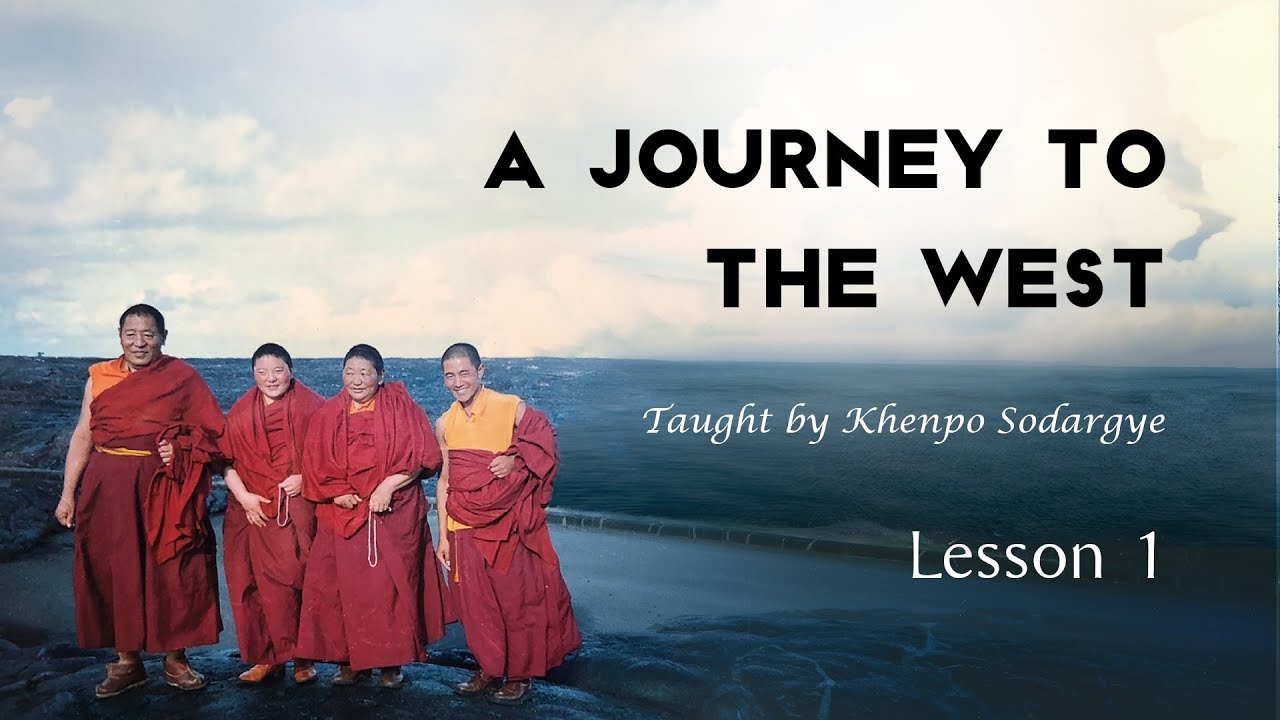
A JOURNEY TO THE WEST: Recollections of Accompanying My Guru to Europe and North America in 1993 provides a detailed account of His Holiness Jigme Phuntsok Rinpoche's journey to Europe and America in 1993 to spread the Dharma, along with his profound teachings. This work is not only a faithful restoration of an important historical period, but also a vivid manifestation of His Holiness's supreme wisdom and compassionate nature, possessing immeasurable religious value and practical guidance for spiritual practice. The book was meticulously compiled from firsthand materials by Khenpo Sodargye, who personally accompanied His Holiness, authentically recreating His Holiness's Dharma-spreading footsteps across Europe and America. From itinerary arrangements to teaching content, from empowerment ceremonies to daily details, everything was recorded with rigorous care, ensuring the authenticity and completeness of this history. During his time in Europe and America, His Holiness transmitted numerous Sutrayana and Vajrayana teachings tailored to the capacities and needs of Western disciples, including extremely profound secret Dharma instructions such as Peaceful Manjushri Sadhana, Jetsun Nyingtig, and Bestowal of Buddha in the Palm of the Hand. These teachings are not only natural expressions of His Holiness's wisdom but also direct revelations of the essence of Buddha-Dharma, possessing tremendous blessing power and practical guidance for meditation. Facing Western audiences with vastly different cultural backgrounds and ways of thinking, His Holiness, with extraordinary skillful means and wisdom, transformed profound Buddhist principles into accessible teachings, demonstrating the universal applicability and vitality of Buddha-Dharma that transcends time and space. The book records how His Holiness, with an equal and inclusive heart, communicated with people of different religious and cultural backgrounds, transmitting the spirit of peace and compassion. His Holiness's Dharma propagation broke with convention by widely transmitting the most secret and supreme Vajrayana teachings of Tibet to destined Western disciples, pioneering the spread of Tibetan Buddhism in the West. This exceptional transmission not only exemplified His Holiness's great compassionate vow but also left precious Dharma lineage transmissions for future disciples. The book offers threefold value to readers: Enhancement of Faith - Through reading about His Holiness's Dharma-spreading deeds and teachings, disciples can deeply experience His Holiness's incomparable compassion and wisdom, thereby developing unwavering faith. The miraculous powers and wonderful abilities His Holiness displayed in the book, along with his earnest care for disciples, inspire later students to practice diligently. Guide for Practice - The numerous teachings and pith instructions included in the book, such as the cultivation of bodhicitta and the direct pointing to the nature of mind in Dzogchen, provide practitioners with clear paths for practice. Whether newcomers to Buddhism or long-time practitioners, all can find key practice points suitable for themselves. Inspiration for Dharma Propagation - His Holiness's successful experience in spreading the Dharma in the West provides valuable reference for contemporary Buddhist teachers. His skillful methods of teaching, keen observation of disciples' capacities, and accurate grasp of temporal circumstances all serve as exemplary models for future Dharma propagators to study. This book is not merely a personal memoir but an important chapter in the history of Buddhist transmission. It records precious moments of Tibetan Buddhism taking root and developing in the West, providing invaluable documentary material for future research on the globalization of Buddhism. For disciples who never had the fortune to meet His Holiness in person, this book serves as His Holiness's presence itself - his blessings and warmth permeate every line. Reading this classic work is like sitting at His Holiness's feet, listening to his earnest teachings, and receiving purification and elevation of the spirit. A JOURNEY TO THE WEST: Recollections of Accompanying My Guru to Europe and North America in 1993 is a masterwork crystallizing His Holiness Jigme Phuntsok Rinpoche's supreme wisdom and compassion, a wish-fulfilling jewel bestowed upon all sentient beings with karmic connection. May readers, through this opportunity, penetrate deeply into the Dharma meaning, practice accordingly, and ultimately realize the ultimate fruition that is indivisible from His Holiness himself.


Type

Teachings of Jigme Phuntsok Rinpoche

10 courses

Type

Buddhist Sutras

14 courses
The Lotus SutraStructured Course

The Lotus Sutra

Teachings by Khenpo Sodargye. The Lotus Sutra (Saddharma Pundarika Sutra) is one of the most important scriptures in Mahayana Buddhism, hailed as the "King of Sutras." Its core teaching is "opening the provisional to reveal the real" and "unifying the three vehicles into one"—the Buddha reveals that the three vehicles (Śrāvaka, Pratyekabuddha, and Bodhisattva) are merely skillful means, and ultimately there is only One Buddha Vehicle, meaning all sentient beings can attain Buddhahood. The sutra expounds the philosophy of "true reality of all dharmas" and the "ten suchnesses," using seven parables including the Burning House to illustrate the Buddha's original intent in appearing in the world. Divided into the first fourteen chapters of the Trace Gate and the latter fourteen chapters of the Origin Gate, it reveals the Buddha's true state of having attained enlightenment since the remote past, emphasizing the immeasurable merit of upholding and reciting this sutra. Teachings by Khenpo Sodargye.The Lotus Sutra (Saddharma Pundarika Sutra) is one of the most important scriptures in Mahayana Buddhism, hailed as the "King of Sutras." Its core teaching is "opening the provisional to reveal the real" and "unifying the three vehicles into one"—the Buddha reveals that the three vehicles (Śrāvaka, Pratyekabuddha, and Bodhisattva) are merely skillful means, and ultimately there is only One Buddha Vehicle, meaning all sentient beings can attain Buddhahood. The sutra expounds the philosophy of "true reality of all dharmas" and the "ten suchnesses," using seven parables including the Burning House to illustrate the Buddha's original intent in appearing in the world. Divided into the first fourteen chapters of the Trace Gate and the latter fourteen chapters of the Origin Gate, it reveals the Buddha's true state of having attained enlightenment since the remote past, emphasizing the immeasurable merit of upholding and reciting this sutra.

The Diamond SutraStructured Course

The Diamond Sutra

The Diamond Sutra L1 1 The Ultimate Guide to Inner Peace: Mastering the Diamond Sutra The core message of this lesson is simple yet profound: The Diamond Sutra is the ultimate wisdom for taming the restless mind. It utilizes the concept of "Emptiness" (Sunyata) to dismantle our rigid attachments to external appearances—be it wealth, physical beauty, or complex emotions. It reveals a radical truth: our suffering stems from mistaking the illusory for the real. Even if the profound theories seem out of reach, sincere recitation offers a powerful "blessing force." For the modern individual navigating a world of chronic anxiety, this practice provides an anchor of stillness and a source of indestructible inner strength. Highlights 1. On the Core of Emptiness All that has a form is deceptive and illusory. When you perceive that all forms are, in essence, formless, you perceive the True Nature of Reality (the Tathagata). 2. Emptiness as an Antidote to Suffering o truly counteract the afflictions within one’s own stream of consciousness and master the mind, the realization of Emptiness is the supreme nectar and the ultimate remedy. 3.Buddhism: The Earliest Science of the Mind Many experts across various scientific disciplines have discovered that while modern science has achieved groundbreaking breakthroughs in the material world, it remains largely at a loss regarding the human psyche. Beyond the study of matter, science has yet to provide definitive answers about the nature of the mind itself. 17791847 4. Limits of Science vs. Value of Dharma 5. Consciousness and Quantum Theory John von Neumann, the renowned father of modern computing, proposed a theory in quantum mechanics: the world is not composed of matter alone; it involves the participation of consciousness, which directly influences the physical realm. While debated within the scientific community, this theory mirrors the profound Buddhist principle that 'all phenomena are created by the mind alone.' 6. Emptiness in Daily Life The entire world is in a frantic chase, driven by an attachment to external 'forms.' Yet, these forms are merely mental constructs. Beyond our subjective perceptions, even scientists struggle to find an objective, solid entity—for at the level of quantum mechanics, everything dissolves into mere probability. 7. Attachment to Illusion: The Root of Suffering Sentient beings mistake that which is substanceless for something real; once this is truly realized, the truth stands revealed. This is no mere hyperbole. By relying on the wisdom of Emptiness (Prajna), the pressures, pains, and fears of life genuinely evaporate. Without it, no matter how hard we strive, suffering is inevitable. The wealthy have their lamentations, and the poor have their cries; everyone, regardless of status, endures their own unique form of suffering. This seemingly "familiar" classic conceals merits far beyond imagination. It is the most precious gift the Buddha left to sentient beings in this age of Dharma decline — a "King of Sutras" whose merit is inconceivable, whose attainments are swift and direct, and whose protection is unparalleled. The Buddha himself told Subhuti: even if one were to fill the entire trichiliocosm with the seven treasures and offer them all as a gift, the merit gained — though vast — would be far surpassed by the merit of upholding this sutra, even just four lines of verse, and teaching it to others. Material generosity can only relieve beings' temporary hunger and thirst, but the generosity of Dharma cuts through the fundamental ignorance that has existed since beginningless time. Vasubandhu summarized the merits of reciting the Diamond Sutra into four aspects: obtaining vast merit, being able to accomplish difficult deeds, receiving the reverence of celestial beings, and becoming equal to the body of the Buddha. And if someone were to offer their body in charity as many times as there are grains of sand in the Ganges — morning, noon, and night — repeating this across immeasurable eons, the merit accumulated would already be immense. Yet if someone hears this sutra and gives rise to an irreversible faith, their merit surpasses even that — to say nothing of those who copy, uphold, recite, and explain it to others. To give rise to even a single thought of faith in the teaching of emptiness carries merit that surpasses countless offerings of one's own life and body. The Diamond Sutra is rightly called the King of Sutras because it directly expounds the nature of Prajña emptiness — the source from which all Buddhas and supreme Bodhi arise. In this age of Dharma decline, the Buddha appears in the form of written words, and this sutra is inseparable from the Buddha himself. Those who recite the Prajña sutras are messengers sent by the Tathagata, carrying out the work of the Tathagata. The Mahāyāna Ghanavyūha Sutra states that those who can recite or carry this sutra may purify even the five heinous crimes — such a person is truly a living stupa. The merits and benefits of the Diamond Sutra, even if proclaimed directly by the Buddha, could not be fully expressed across hundreds of thousands of millions of eons. Precisely because it is so supremely precious and rare, we should all the more cherish this difficult-to-encounter Dharma connection. May all those with the affinity be able to form a bond with this sutra — to copy it, uphold it, recite it, and explain it to others — and thereby find peace and ease in this life, and ultimately attain Buddhahood.

Type

Mind Training

12 courses
Teachings on Guru YogaStructured Course
Teachings on Guru Yoga

Teachings by Khenpo Sodargye.This teaching coincides with the thirtieth anniversary of His Holiness Jigme Phuntsok Rinpoche's composition of this practice liturgy. At the request of his disciples, Khenpo Sodargye offered this explanation before the autumn retreat at the institute, with the intention of reminding everyone of the importance of guru yoga. For practitioners, through sincere faith and prayer, one connects directly with the wisdom state of the guru, allowing blessings to merge into one's mindstream like "pouring from a full vase." This is an efficient and direct method of mind training that is particularly suited to the pace of life and mental dispositions of our present era. The teaching provides a detailed analysis of the core of actual practice—faith. Through scriptural authority and logical reasoning, it thoroughly dispels doubts that "the guru's blessing power diminishes after passing away," and elucidates the profound principle of "viewing the guru as Buddha": the guru's wisdom mind is the Dharmakaya Buddha, his activities are the activities of Buddha, and his kindness surpasses even that of the Buddha, because it is in this very era that the spiritual teacher personally transmits the teachings of liberation to us. If practitioners can visualize and pray with intense gratitude and faith, visualizing the guru's essence as Manjushri (the embodiment of all Buddhas' wisdom) with the majestic appearance of His Holiness Jigme Phuntsok Rinpoche, and between sessions regard everything seen and heard as manifestations of the guru's qualities, they will most swiftly purify karmic obscurations and transform their mindstream. In summary, the essence of this teaching lies in providing not merely a practice liturgy, but a complete system for integrating practice into life—one that counteracts distraction, generates awareness, and leads to realization of the ultimate nature. It encourages practitioners to invest their limited lifetimes in authentic practice that can transcend the cycle of birth and death, and through persevering in this wish-fulfilling jewel of a practice for our "fast-paced era," ultimately achieve the supreme attainment of inseparability with the guru. Teachings by Khenpo Sodargye.A comprehensive explanation of His Holiness Jigme Phuntsok's Guru Yoga practice. Khenpo emphasized avoiding "dry understanding" - spiritual practice must be nourished by bodhicitta and faith. He explained the visualization methods from both the Sutrayana approach of prayer and the Vajrayana methods of generation and completion stages, with particular focus on the profound meaning of the three kayas of the guru: dharmakaya, sambhogakaya, and nirmanakaya, pointing to the essential teaching that "one's own mind is Buddha." He addressed the common confusion among disciples: "Since I never met His Holiness personally, does this create distance and diminish the blessing power?"

Type

Teachings of Guru Rinpoche

9 courses
The Merits of Praying to Guru PadmasambhavaStructured Course

The Merits of Praying to Guru Padmasambhava

Teachings by Khenpo Sodargye.The Most Powerful Protection in the Degenerate Age - Want to Perfect Your Practice in the End Times? Practice Guru Rinpoche's Dharma! In the degenerate age, evil spirits and heretical teachings run rampant. Theory alone cannot subdue inner afflictions - the only secret is Guru Yoga. Practicing Guru Rinpoche's Guru Yoga surpasses practicing a hundred thousand deities! Guru Padmasambhava is the emanation of all Buddhas of the ten directions. He once subdued the demons and obstacles in Tibet and established the pure land of Dharma. Tibetan practitioners achieved rainbow body realization by reciting Guru Rinpoche's mantra 700 million times. Simply chanting "OM AH HUM VAJRA GURU PADMA SIDDHI HUM" can eliminate the five obstacles and accomplish the five wisdoms. The Seven-Line Prayer is the vajra sound uttered simultaneously by all Buddhas! Whoever recites it with faith will surely receive Guru Rinpoche's blessings and presence. Teachings by Khenpo Sodargye.A comprehensive explanation of His Holiness Jigme Phuntsok's Guru Yoga practice. Khenpo emphasized avoiding "dry understanding" - spiritual practice must be nourished by bodhicitta and faith. He explained the visualization methods from both the Sutrayana approach of prayer and the Vajrayana methods of generation and completion stages, with particular focus on the profound meaning of the three kayas of the guru: dharmakaya, sambhogakaya, and nirmanakaya, pointing to the essential teaching that "one's own mind is Buddha." He addressed the common confusion among disciples: "Since I never met His Holiness personally, does this create distance and diminish the blessing power?"

Type

Tantra

1 courses
Luminous EssenceStructured Course

Luminous Essence

🙏 The Guhyagarbha Tantra: Luminous Essence Root Text: The Guhyagarbha Tantra Commentary Author: Mipham Rinpoche Commentary Title: Essence of Clear Light — A General Explanation of Thorough Dispelling of Darkness Throughout the Ten Directions Teaching Master: Khenpo Sodargye Translation Reference: Translated by Lama Chonam and Sangye Khandro (Light of Berotsana Translation Group), guided by Khen Rinpoche Namdrol (Snow Lion Publications) 🙏 Listening Requirement Highest Yoga Tantra empowerment required Those without proper empowerment should not view this content 🙏 About This Teaching The Guhyagarbha Tantra is the supreme Mahāyoga scripture in Nyingma Vajrayāna, known as the King of Old Translation Tantras. It reveals the ultimate non-duality of appearances and emptiness, saṃsāra and nirvāṇa—essential teachings for realizing the Great Perfection view. Mipham Rinpoche's Essence of Clear Light is the most authoritative commentary on this tantra. With exceptional wisdom and clear structure, he systematically presents the foundation, path, and fruition of secret mantra, explaining the eleven tantric topics: view, meditation, conduct, maṇḍala, empowerment, samaya, practice, offerings, activities, mudrās, and mantras. Khenpo Sodargye studied under His Holiness Jigme Phuntsok Rinpoche for over thirty years. In these teachings, he explains the text line by line, using relatable examples to illuminate profound concepts like "primordial purity," helping students unite theory with practice.

Type

Other courses

Structured courses not yet assigned to a course series type.

2 courses