

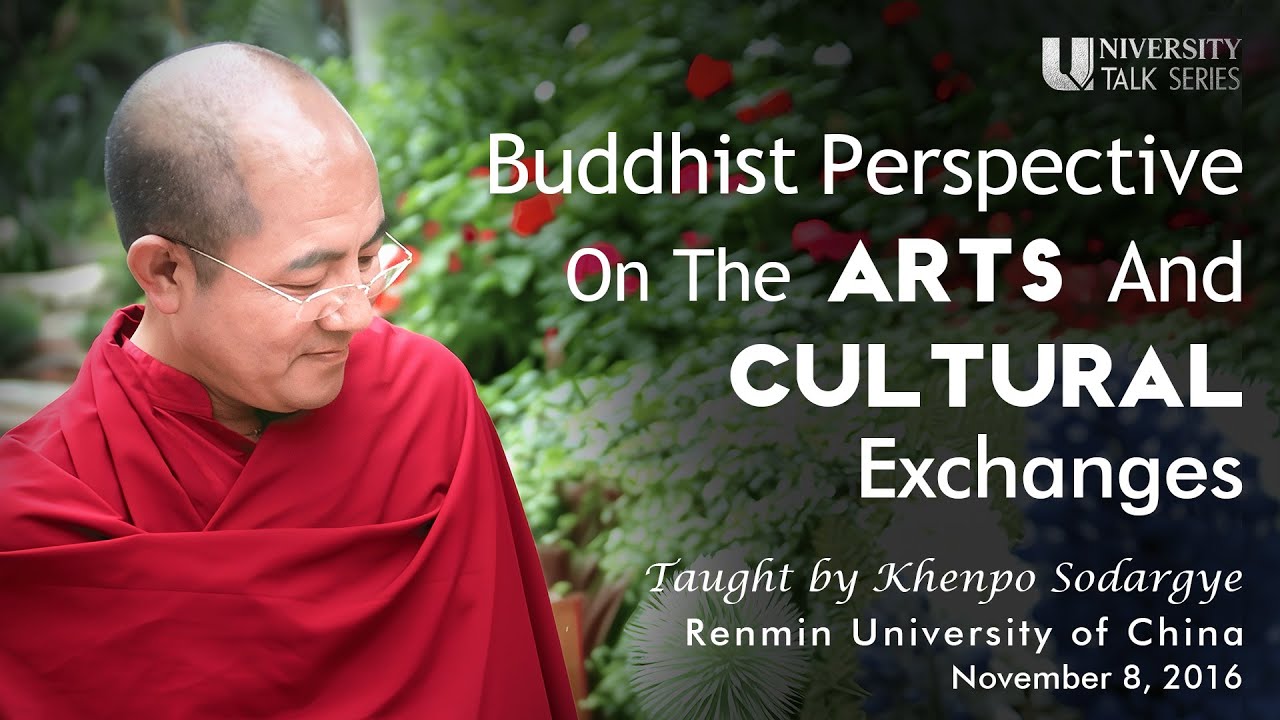
Buddhist Perspective on the Arts and Cultural Exchanges
Buddhist Perspective on the Arts and Cultural Exchanges Khenpo Sodargye explores Buddhist art's profound spiritual power and its role in bridging Eastern and Western cultures at Renmin University of China's School of Arts. This is a lecture given by Khenpo Sodargye at the School of Arts, Renmin University of China on November 8, 2016, with the theme "A Brief Discussion on Buddhist Art—The Relationship of East-West Cultural Exchange." In this lecture, Khenpo explores in depth the unique value and significance of Buddhist art in East-West cultural exchange. He begins by pointing out that art and religion are inseparable, and historically the greatest artworks have mostly originated from religious backgrounds. Khenpo critically analyzes the drawbacks of Western individualism and anthropocentrism, arguing that material progress does not represent spiritual progress. He emphasizes that truly outstanding artworks require creators to possess a pure and focused state of mind, rather than impatiently pursuing efficiency and profit. Through comparing ancient and modern artistic creation, Khenpo notes that ancient artists could spend decades or even centuries completing a work—this "craftsman spirit" aligns with Buddhism's concept of "taming one's mind." He particularly introduces thangka art, explaining how the painter's mental state directly determines the vitality of the work. Khenpo believes the ultimate purpose of Buddhist art is not merely to express truth, goodness, and beauty, but to guide people in recognizing their true nature and allowing the mind to return to naturalness and tranquility. He calls on young artists to value tradition, respect culture, and create works with profound meaning and positive energy using a pure heart, rather than merely seeking attention. 2016118,"——" ,,,,,,,, ,,,,,,,
Watch now