Conversation Series

Talks, dialogues, and symposia

Talks

University Lectures

85 talks
Is Buddhism Outdated? Wisdom for an Era of ChangeTalk

Is Buddhism Outdated? Wisdom for an Era of Change

Ancient Wisdom of Buddhism in Contemporary Society The main speaker of this session is Khenpo Sodargye This is a lecture given by Khenpo Sodargye on November 7, 2013, at Capital University of Economics and Business, with the theme "Ancient Wisdom of Buddhism in Contemporary Society." Khenpo's core perspective is that Buddhist wisdom is preserved in the Tripiṭaka; its Four Dharma Seals and Six Pāramitās of altruism can solve modern people's psychological problems. He develops his argument on four levels: First, the treasure of wisdom—the Kangyur and Tengyur of Tibetan Buddhism, over 200 volumes, are completely preserved at Derge Parkhang; modern science has a blank slate in spiritual research while Buddhism has sublime methods for training the mind. Second, the truth of the Four Dharma Seals—impermanence, suffering (both rich and poor have suffering), non-self (no real "I" can be found in body, mind, or speech), and nirvana; these have remained unrefuted for 2,500 years. Third, taming the mind—using mindfulness and vigilance to observe that the essence of emotions is empty and luminous; the Platform Sutra of the Sixth Patriarch states "afflictions are bodhi." Fourth, the Six Pāramitās of altruism—generosity, discipline, patience, diligence, meditation, and wisdom are the core of Mahāyāna; Germans reading books on the subway exemplifies diligence. Khenpo emphasizes: over 200,000 people commit suicide annually due to lack of faith; the medicine for mental illness lies in Buddhist wisdom. 2013117 20

Spirituality in Everyday LifeTalk

Spirituality in Everyday Life

Spirituality in Everyday Life The main speaker of this session is Khenpo Sodargye This is a lecture given by Khenpo Sodargye on June 24, 2010, at Peking University, with the theme "Spirituality in Everyday Life." Khenpo's core perspective is that correct religious faith is established on the foundation of rational wisdom; Buddhism's wisdom and compassion surpass all else and have incomparable value for humanity. He develops his argument on four levels: First, faith ≠ superstition—correct faith requires relying on wisdom through long-term observation and repeated comparison to establish unwavering confidence, not blindly following others or frantically chasing celebrities. Second, the relationship between religion and science—Einstein said "science without religion is lame, religion without science is blind"; Buddhism's great compassion encompasses all sentient beings, embodying the Bodhicaryāvatāra's teaching "beings wish to banish suffering yet run toward suffering's causes; foolishly craving bliss, they destroy it as they would a foe"; Lu Xun, after reading the Sūtra of the Wise and the Foolish and Yogācārabhūmi-śāstra, praised "Śākyamuni Buddha is truly a great sage"; the Kālacakra Tantra, without any instruments, accurately calculated the sun's movement and solar/lunar eclipses to within one hour; Toynbee said "what can save 21st-century human society is only Confucian-Mencian philosophy and Mahāyāna Buddhism." Third, Buddhism's effect on the mind—during the Yushu earthquake, Tibetans whose entire families died still held prayer wheels, recited Avalokiteśvara's mantra with smiles on their faces because they understood the "Four Inevitabilities of Impermanence" (what is gathered will separate, what is accumulated will be exhausted, what is born will die, what is high will fall); journalists were shocked at how different this was from Wenchuan. Fourth, "religion is the opium" was misunderstood—in the 19th century, opium was an expensive analgesic; the metaphor referred to religion's function, not its essence. 2010624, ,:≠——,;—— , , ,,"21";—— ,; ——19

The Buddhist Perspective on Low-Carbon LivingTalk

The Buddhist Perspective on Low-Carbon Living

Khenpo Sodargye teaches at Guangxi University that reducing greed and cultivating contentment is the fundamental solution to environmental pollution, explaining how Buddhist principles of few desires and contentment can achieve true low-carbon living and sustainable development for humanity. , Website 🔗https://firelotus.ai/ This is a lecture given by Khenpo Sodargye at Guangxi University on February 27, 2012, with the theme Buddhist Low-Desire Living. In this lecture, Khenpo profoundly analyzes the root cause of today's global environmental crisis from a Buddhist perspective—humanity's unrestrained greed. He points out that environmental problems such as water pollution, deforestation, and ozone layer destruction essentially stem from people's excessive consumption and waste in clothing, food, housing, and transportation. Khenpo proposes that the key to achieving true low-carbon living lies in low-desire —disciplining the mind and cultivating contentment with few wants. He emphasizes that even possessing all the world's wealth cannot bring happiness if the heart is filled with greed; conversely, those who know contentment can attain genuine happiness even with simple material conditions. Through comparisons between past and present, East and West, Khenpo illustrates that modern people's pit of desire can never be filled, and this endless pursuit is destroying the Earth. He calls on the audience to reflect: environmental protection is not merely an external technical issue, but requires inner environmental protection. Only by reducing greed through daily practice can we fundamentally protect the environment while attaining inner peace and happiness. 2012227

The Limits of Memory: Why We Forget Our Past LivesTalk

The Limits of Memory: Why We Forget Our Past Lives

The Mystery of Past Lives Summary Is consciousness merely a byproduct of the brain, or does it possess a continuity that transcends physical death? This video explores the logic of life's continuity through the lens of Nobel-winning neuroscience and rigorous debate, challenging us to reconsider the boundaries of existence beyond blind faith. This is a lecture by Khenpo Sodargye at the University of Toronto on October 30, 2014, on the theme of "The Mystery of Past Lives" In response to modern people's ignorance and fear of life and death, Khenpo prescribes the remedy: establishing a correct worldview of past and present lives. His core argument: there are two reasons why people don't care about the truth of life—mainstream culture emphasizes material over spiritual values, and information overload leads to restlessness and distraction. Through rigorous logical reasoning, Khenpo refutes the view that "consciousness arises from matter," demonstrating that consciousness can only arise from previous consciousness. He cites scientific research and numerous cases of past-life recall to prove that life does not end with death. Key insight: not remembering past lives doesn't mean they don't exist, just as underground treasures and inner potentials remain undiscovered. Khenpo emphasizes: if past lives exist and we know nothing about them, this is humanity's enormous loss and tragedy. A correct worldview can make one's life, family, and the world all better. 20141030

Mindset in Turbulent Times: Finding Balance in UncertaintyTalk

Mindset in Turbulent Times: Finding Balance in Uncertainty

A Calm Mind in Times of Turbulence The main speaker of this session is Khenpo Sodargye A Calm Mind in Times of Turbulence Khenpo Sodargye at University of Chicago In this timely and profoundly relevant lecture delivered at the University of Chicago's Bond Chapel, Khenpo Sodargye Rinpoche addresses one of our era's most pressing questions: How do we maintain inner peace when the world around us seems increasingly chaotic? Speaking at the end of 2017—a year marked by political upheaval, technological disruption, and unprecedented social change—Khenpo offers ancient Buddhist wisdom for navigating modern turbulence. From artificial intelligence replacing 77% of jobs in China to mass shootings, from political polarization to the rapid obsolescence of knowledge itself, we face challenges our ancestors never imagined. Even scientist Stephen Hawking warned this is humanity's most critical moment in history. In such times, how do we respond? Khenpo presents a practical four-step framework drawn from Buddhist psychology: **Equanimity, Insight, Acceptance, and Going with the Flow**—tools for transforming chaos into clarity, fear into wisdom. This lecture transcends political divisions and cultural boundaries to address the universal human need for mental stability amid constant change. Whether you're facing career disruption, relationship challenges, personal loss, or simply the overwhelming pace of modern life, Khenpo's teachings offer a roadmap for finding peace not by controlling circumstances, but by transforming your relationship with them. ,:,?2017 77%,,,,?:****

Why Did the Whole Class Applaud When a Student Died? The Chilling TruthTalk

Why Did the Whole Class Applaud When a Student Died? The Chilling Truth

Heartfelt Advice on Happiness to University Students Chapter Title Mapping Depression and suicide are becoming alarmingly common among college students; a classroom of kids applauds upon hearing a competitor has died, yet Socrates once saved a man who had left him to drown—why? In this candid dialogue with university students, Khenpo Sodargye dissects the disturbing truth behind these phenomena and offers concrete solutions to heal a fractured generation. This is a lecture given by Khenpo Sodargye on November 23, 2016, at Shanghai Jiao Tong University, with the theme "Heartfelt Advice on Happiness to University Students." Khenpo's core perspective is that true happiness comes from inner wisdom and altruistic spirit, rather than external material accumulation. He develops his argument on three levels: first, young people should realistically plan their lives—having dreams while also preparing psychologically for setbacks, avoiding mental health issues caused by excessively high expectations; second, in education, "teachers who impart knowledge are easy to find, but teachers who guide character are rare"—teachers should not only transmit knowledge but also care for students' spiritual well-being and convey values of good and evil, beauty and ugliness; third, life's value should be built on an altruistic foundation—if one focuses on the "eight worldly dharmas" (pursuing praise, status, pleasure, and success), one will only become increasingly fragile and suffer. Khenpo emphasizes that soft power is more important than hard power—even with superior material conditions, without compassion, wisdom, and inner strength, one cannot be truly happy. He calls for constantly maintaining a grateful heart, especially toward parents and teachers. 20161123 , ,,",",,,, ————,,,,

The Unique Culture of TibetTalk

The Unique Culture of Tibet

The Unique Culture of Tibet The main speaker of this session is Khenpo Sodargye This is a lecture given by Khenpo Sodargye on November 27, 2013, at National Taiwan Normal University, with the theme "The Unique Culture of Tibet." Khenpo's core perspective is that Tibetan culture is pluralistic, inseparable from Buddhism, and possesses robust vitality; its spiritual essence lies in the "Sixteen Human Codes" promulgated by Songtsen Gampo. He develops his argument on four levels: First, the pluralism of Tibetan culture—it absorbed cultures from China, Nepal, Iran, and other countries, encompassing the Five Major Sciences (medical science, logic, Buddhist studies, linguistics, and arts and crafts) and the Five Minor Sciences (poetics, drama, astronomy, etc.). Second, its inseparability from Buddhism—Khenpo grew up immersed in the Buddhist world; 99% of Tibetans practice Buddhism; after the Yushu earthquake, Tibetans faced immense suffering yet maintained smiles and composure. Third, its robust vitality stems from the "Sixteen Human Codes"—including revering the Three Jewels, honoring parents (Tibetans prioritize parents even in poverty), respecting the virtuous, benefiting neighbors, eliminating jealousy, etc. Fourth, the true scenery lies within—cameras cannot capture the wisdom of the Tibetan Canon in Tibetans' hearts. Khenpo emphasizes: recognizing the mind's true nature and benefiting all people is the ultimate meaning of Tibetan culture. 20131127 99%

The Science of the Mind meets The Science of the Body: An unexpected dialogueTalk

The Science of the Mind meets The Science of the Body: An unexpected dialogue

Buddhism and Health Management Currently, we have advanced MRI technology, yet we cannot cure anxiety; we live longer, but often feel miserable; and standard treatments frequently fail for certain chronic illnesses. Why? In this groundbreaking dialogue with medical experts, Khenpo Sodargye challenges the very definition of health. He explains why conventional medicine hits a wall with chronic conditions, bridging the gap between ancient healing wisdom and modern science to reveal a holistic mind-body therapy capable of curing the "root causes" that technology cannot touch. This is a lecture given by Khenpo Sodargye on June 10, 2017, at Beijing University of Chinese Medicine, with the theme "Buddhism and Health Management." Khenpo begins with a comparison between past and present: in ancient times, medical conditions were poor but people's hearts were pure; in modern times, technology is advanced yet spiritual suffering and environmental pollution are severe. He points out the deep alignment between Traditional Chinese Medicine (TCM) and Buddhism: Sun Simiao's statement in Qianjin Fang (Thousand Golden Prescriptions), "Seeking life through killing takes one far from life," perfectly aligns with Buddhist causality; TCM emphasizes holistic perspectives while Buddhism reveals that illness originates from greed, anger, ignorance, and past-life karma of killing; Fan Zhongyan's aspiration "If not a good chancellor, then a good physician" embodies the ancient medical spirit of compassion and healing. Khenpo contrasts modern medicine with Buddhist approaches: modern medicine focuses on rational analysis and external treatment, whereas Buddhism combines rationality with spirituality (debate and prayer), movement with stillness (exercise and meditation), emphasizing purification of the mind at its root. He calls upon medical professionals not to be rigidly rational, but to invoke the blessings of Medicine Buddha and other practices to gain power beyond science, becoming physicians who heal both body and mind. 2017610

How to Become Wealthy with MeritTalk

How to Become Wealthy with Merit

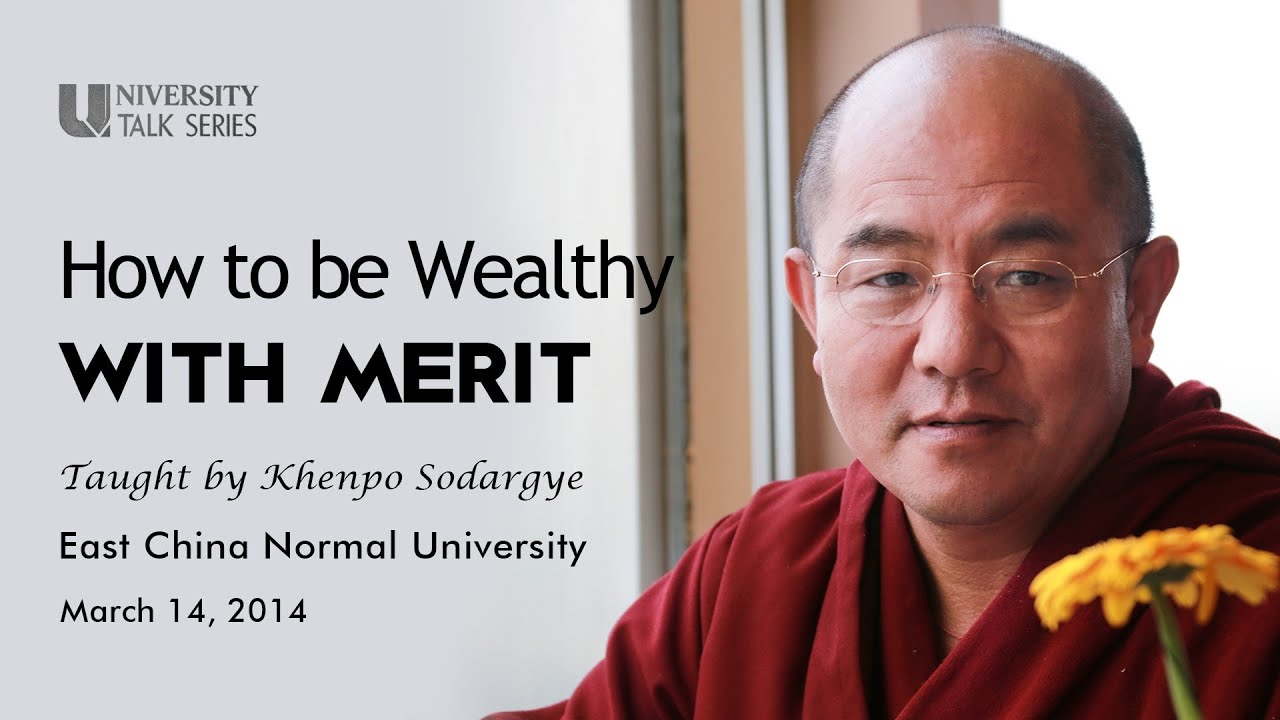
How to Become Wealthy with Merit The main speaker of this session is Khenpo Sodargye How to Become Wealthy with Merit Khenpo Sodargye at East China Normal University In this transformative lecture delivered at the Shanghai MBA Business Wisdom Forum, Khenpo Sodargye Rinpoche challenges the modern equation of wealth with financial success alone. Speaking to a room of MBA students, entrepreneurs, and business professionals, he unveils a radical truth: **true fortune consists of both external wealth (money, possessions) and inner wealth (wisdom, compassion, character)** — and without the latter, the former brings only suffering. At a time when China's GDP has grown exponentially yet spiritual values have declined precipitously, Khenpo addresses the fundamental crisis facing successful people: Why do those with identical abilities and education experience vastly different outcomes? Why does one entrepreneur succeed overnight while another loses everything? The answer lies not in visible conditions alone, but in the **hidden seeds of karma** — the causes and conditions we cannot see with physical eyes. Drawing from Buddhist sutras, Newton's Third Law, and the modern "law of attraction," Khenpo presents a comprehensive framework for understanding merit: **Action and reaction, cause and effect, are not merely Buddhist beliefs but natural laws observable in daily life**. Just as punching a wall brings pain to your own hand, harming others brings suffering back to yourself. Just as planting poisonous seeds yields poisonous fruit, planting virtue yields happiness. This lecture is essential for anyone seeking sustainable success in business and life. Khenpo reveals why a "poverty mindset" of stinginess attracts scarcity while a "wealth mindset" of generosity attracts abundance — not through magical thinking, but through the iron law of causality operating across lifetimes. MBA,MBA,:** **——, GDP,:??,**** ,:**,**,, , ——,

Buddhist Perspective on the Arts and Cultural ExchangesTalk

Buddhist Perspective on the Arts and Cultural Exchanges

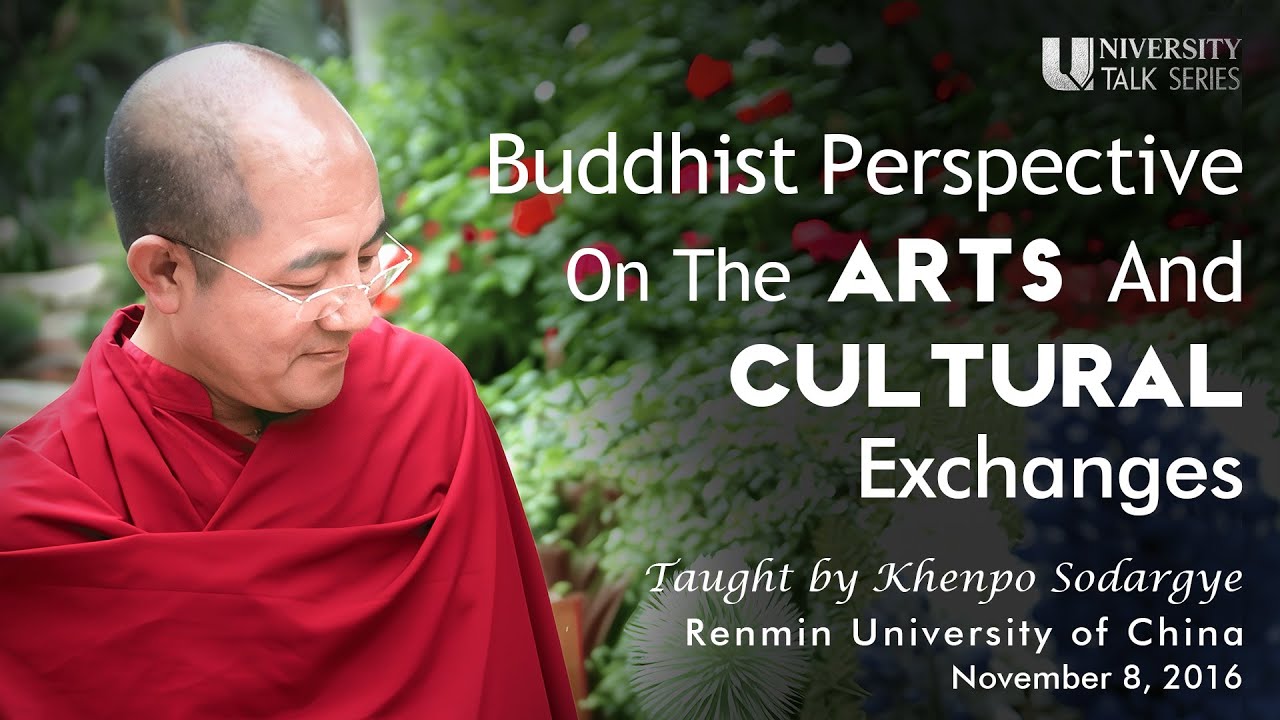
Buddhist Perspective on the Arts and Cultural Exchanges Khenpo Sodargye explores Buddhist art's profound spiritual power and its role in bridging Eastern and Western cultures at Renmin University of China's School of Arts. This is a lecture given by Khenpo Sodargye at the School of Arts, Renmin University of China on November 8, 2016, with the theme "A Brief Discussion on Buddhist Art—The Relationship of East-West Cultural Exchange." In this lecture, Khenpo explores in depth the unique value and significance of Buddhist art in East-West cultural exchange. He begins by pointing out that art and religion are inseparable, and historically the greatest artworks have mostly originated from religious backgrounds. Khenpo critically analyzes the drawbacks of Western individualism and anthropocentrism, arguing that material progress does not represent spiritual progress. He emphasizes that truly outstanding artworks require creators to possess a pure and focused state of mind, rather than impatiently pursuing efficiency and profit. Through comparing ancient and modern artistic creation, Khenpo notes that ancient artists could spend decades or even centuries completing a work—this "craftsman spirit" aligns with Buddhism's concept of "taming one's mind." He particularly introduces thangka art, explaining how the painter's mental state directly determines the vitality of the work. Khenpo believes the ultimate purpose of Buddhist art is not merely to express truth, goodness, and beauty, but to guide people in recognizing their true nature and allowing the mind to return to naturalness and tranquility. He calls on young artists to value tradition, respect culture, and create works with profound meaning and positive energy using a pure heart, rather than merely seeking attention. 2016118,"——" ,,,,,,,, ,,,,,,,

Modernity of Tibetan BuddhismTalk

Modernity of Tibetan Buddhism

Modernity of Tibetan Buddhism From the towering Himalayas to global universities, Tibetan Buddhism continues to thrive in the modern world while many traditions fade. Khenpo Sodargye uses the life of the legendary yogi Milarepa to reveal the secret behind this resilience. He explores five unique aspects—from its logical rigor to its emphasis on real-world application—that allow this ancient wisdom to not only survive but offer powerful solutions to the mental crises of the 21st century. 21 Highlights 1. On Rigorous Logic Tibetan Buddhism differs from other religions; its doctrines are not accepted through dogma or coercion, but rely on rigorous logical reasoning. The Buddha also said in the sutras: "O monks and wise men, just as a goldsmith tests his gold by burning, cutting and rubbing it, so must you examine my words and accept them, but not merely out of reverence." This method of using logical reasoning to determine truth allows Tibetan Buddhism to engage in deep dialogue with modern science. 2. On Pith Instructions English Translation: The Dharma is vast as the ocean; without the Guru's pith instructions, it is difficult to grasp the key points of practice. What are pith instructions? They are the methods by which the Guru points directly to the nature of the mind using the simplest language. These instructions are very practical. Whether you are a highly educated Ph.D. or an illiterate herder, as long as you practice according to the pith instructions, you can receive real benefits. 3. On Self-Grasping and Altruism English Translation: The root of modern people's suffering often lies in excessive "self-grasping." All the troubles we encounter in life ultimately stem from caring too much about "me." Shantideva said in the Bodhicharyavatara: "All the joy the world contains has come through wishing happiness for others. All the misery the world contains has come through wanting pleasure for oneself." This is not moral preaching, but the law of how the mind operates. 4. On Systematic Path English Translation: Tibetan Buddhism is not a pile of fragments, but a complete system. From the beginner's entry to the final realization of Dzogchen, every stage has clear methods and sequences. It is precisely because of such a scientific and rigorous sequence that Tibetan Buddhism has been able to cultivate countless realized masters over thousands of years. [Khenpo Sodargye's Lecture at Northwestern University] Using Milarepa as an example, he expounded on the five characteristics of Tibetan Buddhism's modernity: reverence for teachers, strong logical foundation, systematic and progressive nature, emphasis on actual practice and realization, and strong practicality. He emphasized that Tibetan Buddhism values not only theoretical research but also practical cultivation, effectively addressing modern people's spiritual issues, which is a key reason for its global popularity. []

Universal love and forgiveness: embracing all beingsTalk

Universal love and forgiveness: embracing all beings

Ever Growing, Ever Perfecting The main speaker of this session is Khenpo Sodargye This is a lecture given by Khenpo Sodargye on November 6, 2013, at Peking University, with the theme "Ever Growing, Ever Perfecting." Khenpo's core perspective is that life's growth and perfection require kindness (life's nutrients), compassion (life's elevating element), science (life's enabling force), and ideals (life's expanding dimension). He develops his argument on four levels: First, kindness is the foundation of being human—His Holiness Jigme Phuntsok said a kind heart and virtuous conduct are the foundation of being human; Eisenhower rescued an elderly couple and altered his route, thereby avoiding a Nazi assassination, demonstrating how a kind heart protects oneself; an archaeological team buried skeletal remains and used the grave markers as route markers to exit the Sahara Desert, concluding "kindness is the signpost we leave for ourselves." Second, compassion is the foundation of noble morality—Schopenhauer said the mind wishing others happiness is the foundation of noble morality; Buddhism's boundless great love includes even enemies and animals; the author of The Learning Revolution said the highest realm of education is students' harmony with themselves, surrounding life, and nature. Third, science has two sides—Zhu Qingshi said "when scientists arduously climb to the mountaintop, Buddhist masters have already been waiting there for a long time" because quantum mechanics and chemistry perspectives were already clearly explained in the Śūraṅgama Sūtra and Yogācārabhūmi-śāstra. Fourth, ideals expand life—a Harvard study found 15 people with lofty ideals possessed more wealth after 20 years than the combined total of 85% of others; Churchill's secret to success was three "never give ups." 2013116 152085%

The Ultimate Wealth Mindset: Why Altruism is the Best Self-Interest?Talk

The Ultimate Wealth Mindset: Why Altruism is the Best Self-Interest?

Wisdom in Life, Harmony in Society In an era where money reigns supreme, why is "altruism" the greatest wisdom? Khenpo Sodargye visits a finance university to reveal the ultimate wealth code for a happy life and a harmonious society. Khenpo Sodargye unveils the secret to building a harmonious society through altruistic wisdom, addressing modern challenges in finance, education, and moral values. , This is a lecture given by Khenpo Sodargye on September 28, 2013, at Guangdong University of Finance, with the theme "Wisdom in Life, Harmony in Society." Khenpo's core perspective is that a wise life is one with altruistic wisdom, and a harmonious society is built upon the foundation of compassion. He develops his argument on four levels: First, altruistic wisdom—wisdom must be connected with altruism to be great wisdom; otherwise, it becomes mere cleverness that harms both self and others. The wisdom of evaluating people by virtue and talent in Zizhi Tongjian (Comprehensive Mirror in Aid of Governance) is worth learning. Second, believing in karmic causality—destiny is the manifestation of karma, not fatalism; actions in this life affect future lives, which is wisdom spanning lifetimes. Third, cultivating complete character—modern education lacks character education; Warren Buffett's willingness to "trade bread for a daffodil" embodies values that transcend materialism. Fourth, guarding against greed—Leo Rosten died because his "awakening came too late" due to greed for wealth; excessive attachment ruins one's future. Khenpo quotes Einstein: "Only a life lived for others is a life worthwhile," calling for building a harmonious society through altruism. 2013928

The 7 Minutes That Broke the World's Heart — Society's DisgraceTalk

The 7 Minutes That Broke the World's Heart — Society's Disgrace

Mental Health and Career Blueprint When 1.3 billion people can't help one fallen elderly person, Khenpo Sodargye reveals the missing piece in modern education that drives students to suicide and society to moral collapse. 13, This is a lecture given by Khenpo Sodargye on November 3, 2011, at Nanyang Normal University, with the theme "Mental Health and Career Blueprint." Khenpo's core perspective is that mental health is more important than physical health, and success must be built upon the foundation of a correct outlook on life and moral values. He develops his argument on four levels: First, revealing contemporary psychological problems—university students face pressures from relationships, interpersonal interactions, and employment; materialism is severe; the "Little Yueyue incident" and the "helping elderly crisis" reflect moral decline. Second, emphasizing the importance of faith—faith provides direction, and Buddhism's compassion and wisdom offer the most perfect methods for mental cultivation. Third, establishing a correct outlook on life—cultivating selfless altruism, understanding of karma, impermanence of all phenomena, and other Buddhist wisdom, being mindful of others like Gandhi. Fourth, reviewing Henan's Buddhist history—from White Horse Temple and National Teacher Huizhong to Master Xiangyan, Nanyang has profound Buddhist heritage. Khenpo quotes Victor Hugo: "Thought can make heaven into hell, and hell into heaven," emphasizing the dominant role of the mind. 2011113

Love with WisdomTalk

Love with Wisdom

Love with Wisdom The main speaker of this session is Khenpo Sodargye This is a lecture given by Khenpo Sodargye on September 12, 2017, at Beijing Huaxia Management College, with the theme "Love with Wisdom." Khenpo's core perspective is that everyone has a treasure of love within their heart that needs to be developed with wisdom; altruism is the highest form of self-interest. He develops his argument on four levels: First, love is everywhere—love is transmitted between parents, teachers, and colleagues; families, schools, and society are all sustained by love. Second, beware of indifference—Apple CEO Tim Cook worries that "humans think like computers, abandoning compassion and values without regard for consequences"; people without moral boundaries are more terrifying than robots. Third, altruism is self-interest—Starbucks insists on "selling experience rather than coffee," putting people first and achieving success; helping others is developing the treasure of goodness within one's own heart. Fourth, great love versus small love—small love (loving family and parents) easily turns to hatred; great love is compassion that brings joy to beings and removes their suffering; Master Āryadeva showed selfless great love by pitying his assassin even as he was stabbed; Steve Jobs's refusal to jump the transplant queue during late-stage cancer exemplified the equality of life. Khenpo emphasizes: artificial intelligence cannot generate love; humanity must rely on the power of love to transcend the world. 2017912

Once a Sage Makes a Vow, It Must Be Fulfilled—Even Two Centuries LaterTalk

Once a Sage Makes a Vow, It Must Be Fulfilled—Even Two Centuries Later

Achieve by Doing The main speaker of this session is Khenpo Sodargye Chapter Title Mapping Everyone thinks their obstacles come from others—until they open a coffin and see a mirror. Khenpo Sodargye's bestselling book hides a complete Tibetan Buddhist practice that no one noticed. This is a lecture given by Khenpo Sodargye on June 22, 2015, at Hainan University, with the theme "Achieve By Doing." Khenpo's core perspective is that true success comes from down-to-earth action, not empty ideals. He develops his argument on five levels: First, he reveals the complete Tibetan Buddhist practice system hidden within his book Achieve By Doing—the Four Common Preliminary Practices (precious human birth, impermanence, suffering of samsara, and karma) and the Six Uncommon Preliminary Practices (refuge, bodhichitta, phowa practice, etc.). Second, he critiques four types of wrong "doing"—doing without moral boundaries (crime), doing without aspiration (drifting through life), doing with half-heartedness (giants in thought, dwarfs in action), and doing only verbally (making promises without fulfilling them). Third, he emphasizes the sacred nature of commitment, illustrated by the story of a child's grave in New York that has been preserved for two hundred years, embodying integrity. Fourth, he points out that success requires accumulation of causes and conditions, warning against the quick-fix mentality of "success studies." Fifth, he calls for cultivating altruism and the Mahayana spirit. Khenpo quotes a Zen koan: "Today is most important"—doing good in the present moment is true achievement. 2015622

The Secret Path of Mind TrainingTalk

The Secret Path of Mind Training

The Secret Path of Mind Training The main speaker of this session is Khenpo Sodargye This is a lecture given by Khenpo Sodargye on November 25, 2013, at National Taiwan University, with the theme "The Secret Path of Mind Training." Khenpo's core perspective is that the Six Pāramitās of Mahāyāna practice (generosity, discipline, patience, diligence, meditation, wisdom) constitute the path of mind training; when the mind changes, the world changes too. He develops his argument on six levels: First, the pāramitā of generosity—giving of wealth, giving of fearlessness, giving of Dharma; Ross Perot, from his mother's teaching to "help them a bit when we have the capacity," cultivated the habit of charitable giving and formed the life pattern for great accomplishment. Second, the pāramitā of discipline—with altruism as the highest principle, including refraining from harmful conduct, gathering virtuous dharmas, and benefiting sentient beings; a Taiwanese scholar said "Without restraint, there is no morality; without morality, there is no freedom or dignity." Third, the pāramitā of patience—enduring suffering, enduring harm, accepting profound truths; during the Cultural Revolution, when a woman had her head half-shaved, a Chan master passed her a note saying "This very moment is the time for practice," and she awakened and persevered. Fourth, the pāramitā of diligence—donning armor, right conduct, non-regression. Fifth, the pāramitā of meditation—a tofu seller sat for half an hour and remembered a debt from thirty years ago, illustrating meditation's value; worldly meditation calms the mind, while transcendent meditation aims for liberation. Sixth, the pāramitā of wisdom—the three wisdoms of hearing, contemplation, and meditation; Madhyamaka theory is the sharp tool for realizing ultimate reality, transcending religion. Khenpo emphasizes: mind is the master and prime mover of all change. 20131125

Scientific Evidence for Achieving Inner Peace Through MeditationTalk

Scientific Evidence for Achieving Inner Peace Through Meditation

Transforming Your Life with the Three Practices The main speaker of this session is Khenpo Sodargye This is a lecture given by Khenpo Sodargye on November 2, 2013, at Jiangxi University of Finance and Economics, with the theme "Transforming Your Life with the Three Practices." Khenpo's core perspective is that the Three Practices (discipline, meditation, and wisdom) constitute the entirety of the Dharma and can bring sustainable happiness—both temporary and lasting, benefiting oneself and others. He develops his argument on three levels: First, discipline safeguards well-being—the Five Precepts for laypeople (no killing, no stealing, no sexual misconduct, no lying, no intoxication) represent the baseline of humanity; sexual misconduct leads to high divorce rates and family disharmony; lying leads to false food advertising causing universal anxiety. Confucius said "A gentleman has three things to guard against"; Mencius said "Without a sense of shame, one is not human." Second, meditation nurtures body and mind—American experiments prove 5-10 minutes of daily meditation reduces brain consumption by 15%, equivalent to 7 hours of deep sleep; Liang Tingcan's statistics show 571 eminent monks averaged 76.4 years, 36.1 years longer than emperors; Master Miaozhi lived to 116 using "Three Diligences (mind, feet, hands), Three Tranquilities (mind, vital energy, conduct), Three Detachments (wealth, power, age), Three Joys (helping others, contentment, inner joy)." Third, wisdom dispels confusion—the three wisdoms of hearing, contemplation, and meditation realize the mind's true nature of emptiness and selflessness. 2013112 5-1015%757176.436.1116

Tibet’s secret to happiness and its universal relevanceTalk

Tibet’s secret to happiness and its universal relevance

The Tibetan Code of Happiness The main speaker of this session is Khenpo Sodargye The Tibetan Code of Happiness Khenpo Sodargye at George Washington University In this deeply moving lecture delivered at George Washington University, Khenpo Sodargye Rinpoche returns to Washington, D.C. twenty years after accompanying his root teacher, His Holiness Jigme Phuntsok Rinpoche, to this very city. Speaking with profound emotion and wisdom, he unveils the "Tibetan code of happiness"—the inner secrets that enable Tibetan people to maintain extraordinary joy and resilience despite life's challenges. At a time when America's GDP has multiplied several times over yet its happiness index continues to decline, Khenpo offers an essential teaching: true happiness cannot be found in external wealth, status, or relationships alone. Drawing from 2,500 years of Buddhist wisdom preserved intact in Tibet, he reveals how contentment, meditation, and altruism form the foundation of lasting happiness—a happiness that no external circumstances can diminish. This lecture represents a historic East-West dialogue on the nature of happiness, combining ancient Buddhist psychology with contemporary scientific research on well-being. Khenpo's teachings are particularly relevant for university students and future leaders who will shape tomorrow's world, reminding us that genuine happiness springs from inner cultivation rather than outer achievement. ,——, GDP,:2500, ,,

Spirituality and Psychological Well-BeingTalk

Spirituality and Psychological Well-Being

Spirituality and Psychological Well-Being The main speaker of this session is Khenpo Sodargye Spirituality and Psychological Well-Being Khenpo Sodargye at Shanghai Jiao Tong University In this urgent and deeply relevant lecture at Shanghai Jiao Tong University's "Science and Happiness Symposium," Khenpo Sodargye Rinpoche confronts China's silent mental health crisis: **Over 30% of Peking University students report feeling lost or out of control. Of 287,000 annual suicides in China, 150,000 are students—70,000-80,000 dying from academic pressure alone.** China, with one-fifth of the world's population, accounts for two-fifths of global suicides. These are not statistics—these are lives lost to a fundamental misunderstanding of what happiness is and where to find it. Drawing from the famous Buddhist text *The Four Hundred Stanzas* by Aryadeva, Khenpo reveals a paradox most modern people cannot accept: **"If you delight in gathering, why not delight in parting? Gathering and parting—aren't both present at the same time?"** Just as birth necessitates death, just as every meeting contains inevitable separation, every happiness carries suffering waiting beside it. The Goddess of Fortune and the Goddess of Misfortune always arrive together—we cannot invite one without the other. This lecture addresses the root cause of modern unhappiness: **We pursue external happiness (wealth, status, love) while ignoring the only source of lasting joy—inner cultivation.** Material civilization has advanced exponentially while spiritual values have declined precipitously. GDP rises while happiness indices fall. Students commit suicide over 6,000 yuan, billionaires commit suicide over billions—the amount of money is irrelevant because external wealth brings only temporary, unstable happiness that quickly breeds new desires. Khenpo presents a revolutionary solution from Mahayana Buddhism: **Self-other exchange meditation **—reversing the habitual pattern of wanting others' wealth for yourself, instead wishing your happiness for others. This practice releases the mind from the prison of self-centered comparison and competition, creating "a very subtle happiness and sense of well-being" that external circumstances cannot destroy. ,:**30%28.7,15——7-8**, ,:**",?,?"**,, ** ——**GDP,——,, ****——,, ,

Discover the Innate Treasure.Talk

Discover the Innate Treasure.

Khenpo Sodargye reveals ancient Buddhist wisdom on discovering inner happiness at the University of Hong Kong, addressing modern stress and the fast-paced lifestyle's impact on spiritual wellbeing. ,, This is a lecture given by Khenpo Sodargye at the University of Hong Kong on November 27, 2011, with the theme "Exploring the Treasure of the Mind." In this lecture, Khenpo first expresses mixed feelings about Buddhism in Hong Kong: joy that HKU values Buddhist studies, but concern that excessive openness has led to a mixture of authentic and inauthentic teachings, with people too busy to study genuine Dharma. He emphasizes that true happiness comes from within, not from external circumstances. Quoting the Bodhisattvacharyavatara, Khenpo points out: if something can be remedied, why be unhappy? If it cannot, what's the use of worrying? He critiques the mistake of placing happiness in wealth, love, status and other external conditions, citing the tragic marriages of Lincoln and Tolstoy as examples of how external conditions are unreliable. Khenpo reveals that everyone possesses the treasure of Buddha-nature (Tathagatagarbha) within, which is the true source of happiness, but it must be unlocked through practice. He explains how sharp practitioners can achieve instant enlightenment through a master's direct pointing, and elucidates the Heart Sutra's teaching that "form is emptiness, emptiness is form," using quantum mechanics as an analogy. Khenpo stresses that life without faith is a tragedy—modern young people, lacking traditional cultural education and faith, become selfish, anxious and empty. He calls on everyone to systematically study Buddhism, cultivate altruism, and recognize the nature of mind, while warning that no matter how high one's realization, one must never disregard cause and effect, maintaining careful conduct in behavior. 20111127

A Buddhist View of HappinessTalk

A Buddhist View of Happiness

A Buddhist View of Happiness The main speaker of this session is Khenpo Sodargye [Khenpo Sodargye's Lecture at London School of Economics and Political Science] The Khenpo introduced Buddhist perspectives on economics and social life from Buddhist scriptures, pointing out that true happiness lies not in external materials, emotions, or arts, but in inner meditation and abiding in one's nature. He emphasized that modern people suffer from psychological problems due to information overload, and suggested achieving inner peace and genuine happiness through mindfulness meditation. [] Highlights 1. Insights on the Source of Happiness Whether rooted in compassion or wisdom, if the motivation is pure, it brings unparalleled benefit to society and humanity as a whole. Yet, a deeper, more profound happiness can likely only be found through spiritual practice. 2. The Power of Meditation Why does meditation hold such power? In daily life, we are constantly besieged by various negative emotions... Once these emotions arise, no amount of material wealth can prevent life from becoming a chaotic, unmanageable mess. 3. The Metaphor of Inner Seeking This metaphor perfectly illustrates that we don't need to search externally for happiness. By simply letting go of negative emotions that are irrelevant and alien to our true nature, and resting in the mind itself, we can instantly discover our authentic, original self. 4. Buddhism's Relevance to Modern Life If you study this philosophical system from 2,500 years ago, you will find it fascinatingly applicable to the complexities of our modern economic life. 5. The Practice and Effect of Mindfulness As we deepen our practice of meditation, our quality of life naturally elevates, becoming more refined. The troubles and suffering of this world stem from a restless and anxious mind; but with a pure and settled mind, one can find joy even in a prison cell or amidst poverty.

"Dad, can I buy an hour of your time?"Talk

"Dad, can I buy an hour of your time?"

Nurture the Heart and Cultivate the Mind A heartbreaking tale of a child scraping together 20 yuan to buy just one hour of his father’s time, contrasted with business titans who make daily meditation a non-negotiable ritual—these striking images pierce the armor of every soul trapped in the urban grind. This talk steers clear of dry theory, offering instead a way to cleanse our dusty hearts as simply as we wash our faces, rediscovering with every breath the true self we left behind at the starting line. 20 Steve Jobs' Hidden Habit: Finding intuition when the world gets loud This is a lecture given by Khenpo Sodargye on October 4, 2013, at East China Normal University, with the theme "Nurture the Heart and Cultivate the Mind." Khenpo's core perspective is that happiness originates from the spirit rather than material possessions, and nurturing the heart is more important than nurturing the body. He develops his argument on five levels: First, establishing correct goals—external wealth brings only temporary happiness, while spiritual wealth bestows lasting great bliss; "all phenomena are created by the mind." Second, the relationship between material and inner worlds—The History of Happiness proves happiness stems from inner peace; Napoleon, though wealthy, was unhappy, while Helen Keller, though disabled, was grateful for life's beauty. Third, the mentality of "good ideals + bad contingencies"—detours are inevitable and require advance psychological preparation. Fourth, methods for mental cultivation—meditate 10-15 minutes daily; Li Ka-shing and Steve Jobs both maintained this practice; eminent monks' longevity also stems from inner purity. Fifth, don't forget family—illustrated by the story of a child "buying" an hour of his father's dinner time with 20 yuan. Khenpo quotes the Yale president: what students need most is a kind heart. Faith brings hope. 2013104 "+"————10-15——20

When God Meets BuddhaTalk

When God Meets Buddha

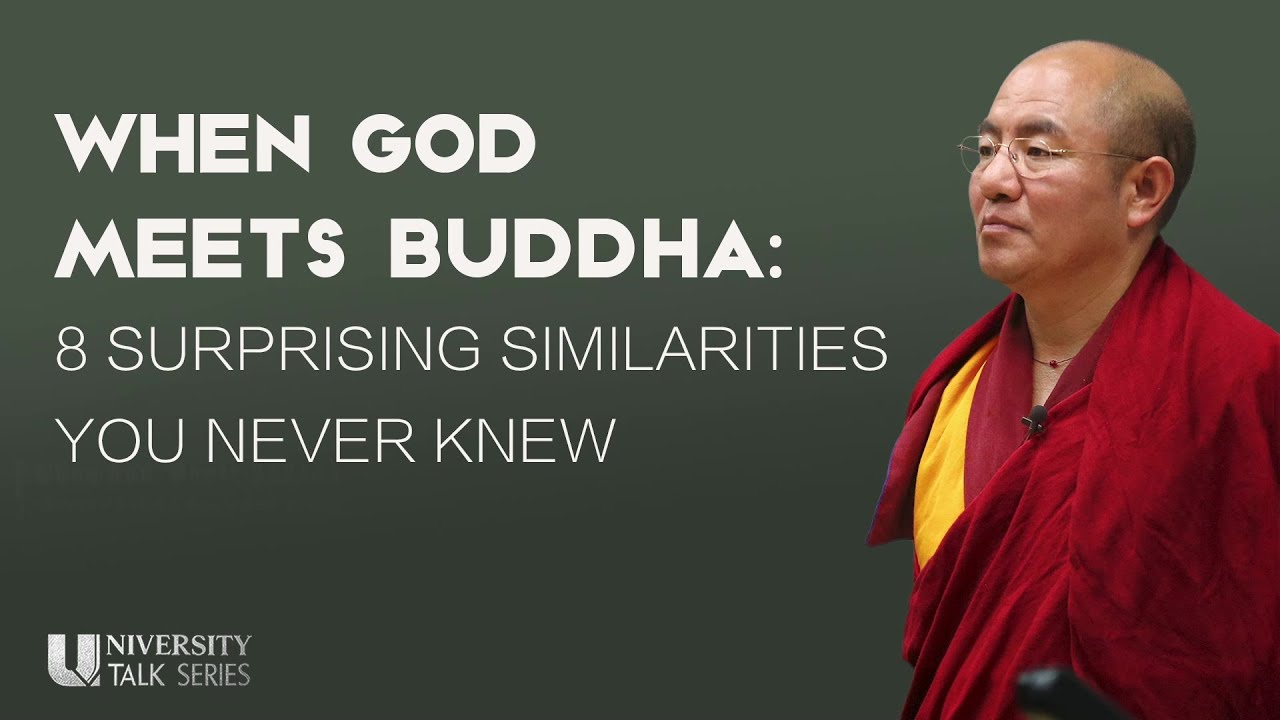
When God Meets Buddha The main speaker of this session is Khenpo Sodargye Interfaith Harmony: A Dialogue Between Buddhism and Christianity In this illuminating talk, Khenpo Sodargye explores the intersections between Buddhism and Christianity, advocating for a world of religious harmony. By examining eight shared pillars—including prayer, patience, compassion, and generosity—Rinpoche demonstrates the universal nature of core spiritual values. He calls upon practitioners of all faiths to honor their own traditions while embracing an open-minded curiosity toward others, working together as a collective force for global peace. Highlights 1. On Prayer in Times of Adversity When we Buddhists face obstacles or misfortunes, we pray to our Teachers and to the Buddha. In the very same way, when Christians encounter hardship and distress, they offer prayers to God and to Jesus. 2. On Forbearance When confronted with adversity, a Buddhist practices forbearance (kshanti) to prevent anger from taking root. Likewise, when Christians meet with trials, they also practice patience and long-suffering, choosing not to harbor hatred. 3. On the Common Values of Religion I have always had a deep interest in many faiths. Why? Because humanity needs a shared set of aspirations and ideals, and religion plays a unique, irreplaceable role in this regard. Although the doctrines of world religions vary, they all serve as forms of education that lead humanity toward goodness and culture toward the light. 4. On the Harmony Between "God and Buddha" What happens when God meets the Buddha? I believe the result is a beautiful spark of harmony, because Christianity and Buddhism share so much common ground. Undeniably, there are differences—but difference does not mean conflict, nor does it necessitate mutual exclusion. Even within Christianity, denominations like Catholicism, Protestantism, and Orthodoxy differ in their dogmas and rituals, yet they do not exist in a state of constant opposition. The same spirit of coexistence should apply between faiths 5. On the Doctrine of Equanimity In Christianity, it is said: 'He makes his sun rise on the evil and on the good, and sends rain on the just and on the unjust.' This reflects God’s impartial compassion for all beings. Similarly, Buddhism teaches: 'All are equal; the sandalwood and the axe are the same.' If one person offers sandalwood to the Buddha and another strikes him with an axe, the Buddha feels no attachment to the former and no resentment toward the latter. His compassion remains equal for both. Even if the ocean could be separated from its waves, the Buddha’s compassionate protection would never leave sentient beings. Thus, whether it is God or the Buddha, the treatment of all people—virtuous or wicked—is characterized by total impartiality. 6. On Mother Teresa and Compassion Most people recoil from beggars with a sense of aversion, yet in Mother Teresa’s eyes, even the beggar was 'lovely.' This is difficult for many to fathom. In Buddhism, we say that whether someone is a Bodhisattva is not determined by their clothing or appearance, but by whether they possess a heart of selfless altruism. If one can offer unconditional protection and aid to any suffering being, that person is a Bodhisattva. 7. The Metaphor of the Religious Family Our world is made vibrant by the colorful diversity of its flowers; this hall today is made beautiful by the various colors of the clothes you wear. In the same way, when each religion showcases its unique charm and value, our global family becomes more beautiful.


In an Age of Crisis of Faith, How Can Traditional Beliefs Safeguard HappinessTalk

In an Age of Crisis of Faith, How Can Traditional Beliefs Safeguard Happiness

Spirituality in Our Time At a Thai international institute, Khenpo Sodargye explores faith versus materialism, warns of commercialism eroding Buddhist traditions, and emphasizes that inner peace brings true happiness beyond wealth. This is a lecture given by Khenpo Sodargye at the International College of Mahidol University in Bangkok, Thailand on November 13, 2013, with the theme "Spirituality in Our Time." In this lecture, Khenpo offers profound reflections on the contradiction between modern economic development and the crisis of faith. He points out that Thailand and Tibet face similar dilemmas: economic development and tourism bring material improvements but may dilute traditional faith, with many young people beginning to view religion as outdated and money as supreme. Khenpo critically analyzes the limitations of scientific omnipotence theory, using examples of regretful scientists like Nobel Physics Prize winner Martin Ryle and Einstein to illustrate that science can also trigger war tragedies—nearly 200 million people died in technologically advanced wars in the 20th century alone. He emphasizes that the spiritual value religion has provided for thousands of years cannot be replaced by science. Khenpo particularly warns that if we pursue economy and material wealth single-mindedly while losing traditional faith, earning more money will not bring true happiness—this explains why many wealthy nations see declining happiness indexes. He calls on young people to not neglect moral cultivation, altruistic hearts, and spiritual faith while pursuing careers and families. Khenpo believes that life is short, and we should not be like ants only concerned with our own busyness, but rather seek balance between material and spiritual aspects, using the power of faith to face difficulties, maintaining courage and patience, and keeping smiles on our faces. 20131113 202